



Taipei City Department of Health Announces 2026 Food Inspection Results for Stir-Fry Restaurants
Publication Date: November 23, 2026
Issuing Division: Food and Drug Management DivisionContact
Person: Section Chief Lin Kuan-Chen
Telephone: 1999, ext. 7086
Mobile: 0979-305-301
Modern consumers have increasingly diverse dietary habits and a wide variety of food choices. With more people dining out and temperatures becoming cooler, freshly prepared hot dishes have become particularly popular among consumers.
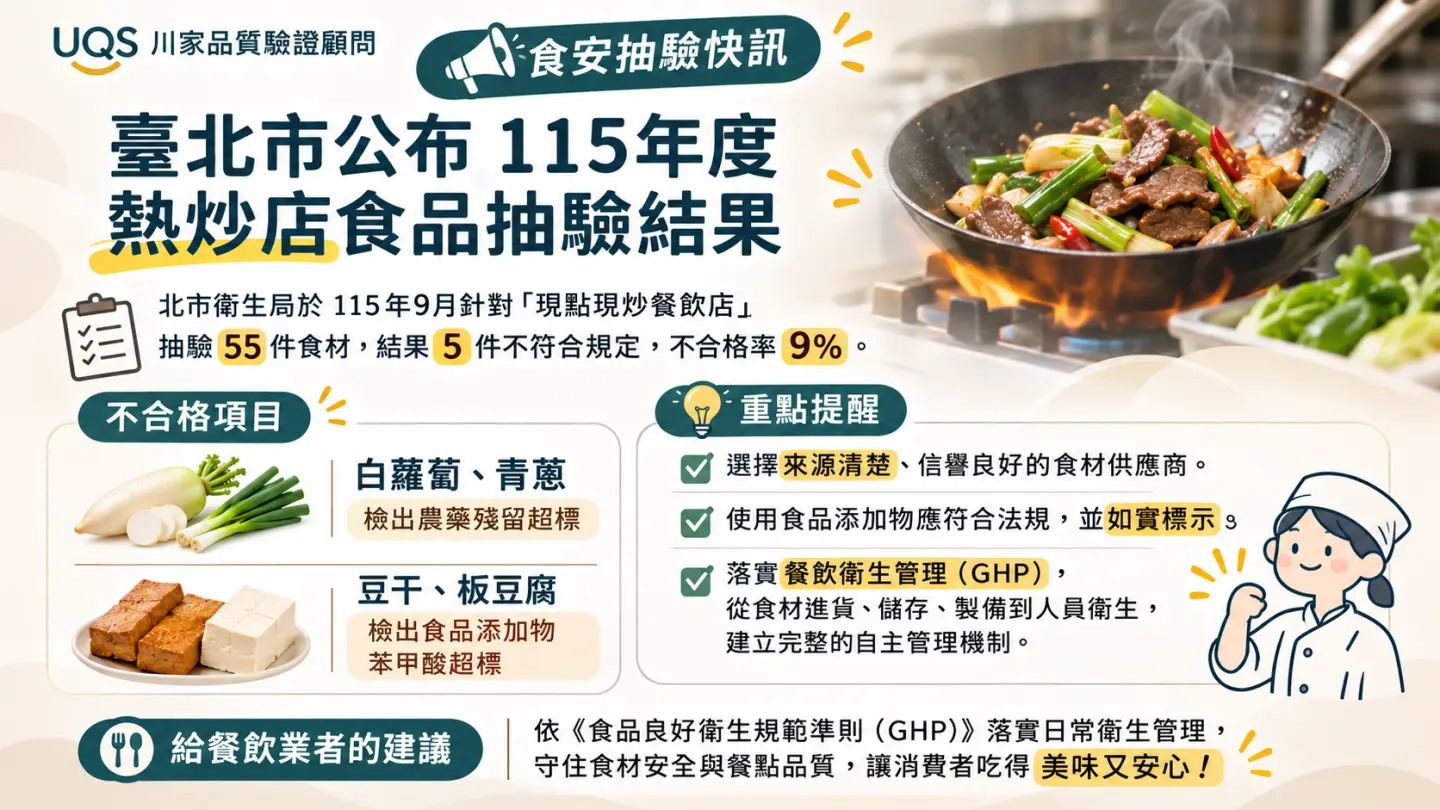
To safeguard food safety, the Department of Health, Taipei City Government, conducted a targeted inspection program in September 2026, sampling ingredients used by restaurants specializing in freshly prepared, made-to-order stir-fry dishes in Taipei City. A total of 55 food samples were collected, of which five failed to comply with regulatory requirements, resulting in a non-compliance rate of 9% (please refer to the inspection results list for details).
The sampled products included vegetables, aquatic products, lamb, soybean products, and peanut products. Depending on the product category, the testing parameters included preservatives, hydrogen peroxide as a sterilizing agent, aflatoxins, ochratoxins, pesticide residues, veterinary drug residues, heavy metals such as lead and cadmium, histamine, volatile basic nitrogen (VBN), and ingredients of animal origin.
Five samples failed to comply with regulatory requirements:
- One white radish sample contained clothianidin residues exceeding the permitted limit.
- One green onion sample contained mepanipyrim residues exceeding the permitted limit.
Both samples failed to comply with the Standards for Pesticide Residue Limits in Foods.
In addition, one sample of dried tofu and two samples of firm tofu contained benzoic acid exceeding the permitted limit, violating the Standards for Specification, Scope, Application and Limitation of Food Additives.
The Department of Health, Taipei City Government, has ordered the businesses selling these non-compliant products to immediately remove them from sale.
Three of the non-compliant products—one white radish, one green onion, and one dried tofu sample—were traced to suppliers located outside Taipei City. These cases have been referred to the respective local health authorities for further action within their jurisdictions.
For the remaining two firm tofu samples, the businesses were unable to provide definitive information regarding their sources. A fine of NT$30,000 was imposed on the business operator pursuant to Article 47, Subparagraph 11 of the Act Governing Food Safety and Sanitation.
The Department of Health emphasized that market sampling constitutes downstream food safety management. Effective reduction of pesticide residues in fruits and vegetables requires proper monitoring at the agricultural production stage, together with enhanced guidance for farmers on the correct application of pesticides during cultivation.
Businesses selling fruits and vegetables should require suppliers to provide complete transaction documents and retain such records. They should also photograph and retain information displayed on product cartons, such as supplier names and supplier identification codes, to facilitate subsequent investigations into the sources of non-compliant products and strengthen source management.
Consumers are advised to purchase products from reputable retailers and, whenever possible, choose products with complete packaging and clear labeling. They should avoid purchasing foods with unusually bright colors, abnormal whiteness, or colors that differ significantly from their traditional appearance.
Food businesses and food service operators are also urged to strengthen self-management throughout food production and preparation processes, including personnel hygiene, workplace sanitation, facility hygiene management, and quality assurance systems. Businesses should source safe and hygienic ingredients from reputable suppliers with traceable origins and strictly comply with the Act Governing Food Safety and Sanitation to protect product safety and consumer rights.
The Department of Health further reminds food businesses that the use of food additives must comply with the Standards for Specification, Scope, Application and Limitation of Food Additives.
Businesses should select ingredients clearly labeled as “Food Additives” and bearing valid food additive product registration codes. Food additives must be used within their permitted scope and maximum usage limits, and their names must be accurately declared on product packaging to protect consumers’ right to know.
Furthermore, hygiene management must be properly implemented throughout food production, distribution, and sales. Raw materials must comply with the Sanitation Standards for Contaminants and Toxins in Food and other applicable regulations.
Pursuant to Article 9 of the Act Governing Food Safety and Sanitation, relevant source documentation must be retained for at least five years to strengthen product traceability management.
For food safety, hygiene, or consumer-related inquiries, members of the public may contact the Taipei Citizen Hotline at 1999, ext. 7079. Callers outside Taipei City may dial +886-2-2720-8889, ext. 7079.
The inspection results and related information are available on the official website of the Department of Health, Taipei City Government:
Original Article:
Taipei City Department of Health Announces 2026 Food Inspection Results for Stir-Fry Restaurants
聯絡我們CONTACT